



All Sensors achieved DIN ISO 14001:2015 certification
Quality you can rely on. Environmental responsibility you can measure.
Quality, reliability and responsible business practices are essential when customers choose a long-term technology partner. At All Sensors GmbH, these principles are not simply aspirations: they are reflected in defined processes, measurable objectives and a commitment to continuous improvement.
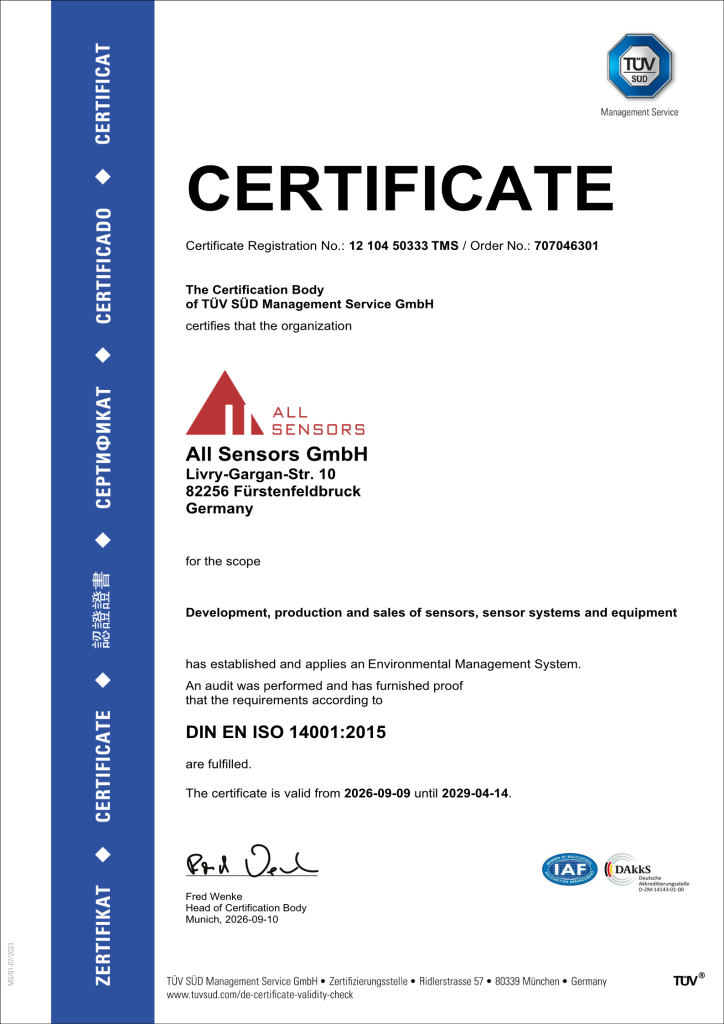
We are therefore pleased to announce an important milestone for our company: our DIN EN ISO 9001:2015 quality management certification has been successfully confirmed, while All Sensors GmbH has achieved DIN EN ISO 14001:2015 certification for its environmental management system for the first time.
Together, these certifications provide independent confirmation of two commitments that are fundamental to the way we work: delivering consistent quality for our customers and systematically improving our environmental performance.

ISO 9001: consistent quality through reliable processes
Environmental responsibility is one part of the picture. Quality remains equally fundamental.
Our renewed DIN EN ISO 9001:2015 certification confirms the continued implementation of our quality management system. ISO 9001 is the internationally recognised standard for quality management systems and focuses on consistent processes, meeting customer requirements and continuous improvement.
For our customers, reliable quality management is particularly important when selecting sensing solutions for demanding applications. Technical specifications are essential, but successful long-term cooperation also depends on dependable processes, clear responsibilities and a consistent focus on customer requirements.
Our two management system certifications therefore complement one another:
- DIN EN ISO 9001:2015: systematic quality management, reliable processes and continuous improvement
- DIN EN ISO 14001:2015: systematic environmental management and continuous improvement of environmental performance
Together, they provide a structured foundation for how we develop our organisation and support our customers.
A team achievement – and special thanks to Markus Gabriel
Management systems are not created by certificates. They are brought to life by the people who implement processes, question established routines, document improvements and make quality and environmental responsibility part of their daily work.
Achieving these certifications has therefore been a genuine team effort, and we would like to thank everyone at All Sensors who contributed to this important milestone.
Our special thanks go to Markus Gabriel, who took the lead on the certification process and successfully guided the project through to completion. His commitment, coordination and persistence played a key role in establishing the required structures and achieving this result.
Thank you, Markus, and thank you to the entire All Sensors team.
Quality and environmental responsibility as part of continuous improvement
Achieving certification is an important milestone, but it is not the end of the process. Both quality and environmental management are based on continual evaluation and improvement.
This principle fits closely with the way we approach sensor technology.
Our customers develop products and systems in which accuracy, reliability and efficiency matter. Whether the application involves medical technology, HVAC, industrial equipment, aerospace or another demanding field, small improvements can make a significant difference to the performance of the overall system.
We apply the same mindset to our own organisation.
Processes can be reviewed. Resources can be used more efficiently. Objectives can be refined. Environmental performance can be measured. Quality can be improved.
For us, precision and responsibility therefore go hand in hand.
Precision. Quality. Responsibility.
For our customers and partners, our certifications provide independent confirmation that quality management and environmental responsibility are systematically integrated into the way All Sensors operates.
For us, they are also a commitment for the future.
We will continue to improve our processes, examine opportunities to use resources more efficiently and provide our customers with the reliable sensor solutions and personal support they expect from All Sensors.
Because progress is not about reaching a point at which there is nothing left to improve. It is about continually asking what can be done better.
What does ISO 14001 certification mean?
ISO 14001 is the internationally recognised standard for environmental management systems. It provides organisations with a structured framework for identifying, managing and continually improving their environmental performance.
Rather than treating environmental responsibility as a stand-alone initiative, an environmental management system integrates it into everyday business processes. This includes identifying relevant environmental aspects, defining objectives, monitoring performance and taking action where improvements can be made.
The framework addresses areas including the efficient use of energy and resources, waste reduction, environmental obligations and the continuous improvement of environmental performance.
For customers and business partners, ISO 14001 certification therefore provides something particularly valuable: transparency and confidence. Environmental responsibility is supported by systematic processes and measurable objectives rather than being based on statements of intent alone.
Why ISO 14001 matters for B2B customers and partners
Environmental requirements are becoming increasingly relevant throughout industrial supply chains. Companies are expected to understand not only their own environmental impact but also how their suppliers and business partners approach environmental responsibility.
A certified environmental management system provides a recognised framework for this.
For B2B customers, working with an ISO 14001-certified partner can support supplier assessments, procurement processes and their own environmental and sustainability objectives. It demonstrates that environmental considerations are systematically incorporated into the organisation and subject to continuous improvement.
At All Sensors, this approach complements the precision and reliability expected from our sensor solutions. From the products we provide to the processes behind our business, our objective is to make improvement systematic rather than occasional.
Looking ahead: the transition to ISO 14001:2026
Environmental management continues to evolve. A new edition, ISO 14001:2026, was published in April 2026 and succeeds ISO 14001:2015. Among other developments, the updated standard provides clearer guidance and strengthens alignment with current environmental priorities such as climate change, biodiversity and resource efficiency.
Organisations currently certified to ISO 14001:2015 are transitioning to the new edition according to the applicable certification arrangements. For All Sensors, this development fits naturally with the fundamental principle behind our environmental management system: continuous improvement.
Certification gives us a framework. What matters in the long term is how we use that framework to keep developing our processes and environmental performance.