


Sensor Signal Processor (SSP): Function, Benefits and Key Parameters
A Sensor Signal Processor (SSP) is an integrated electronic circuit that converts raw sensor signals into accurate, stable and usable measurement data. It combines signal amplification, analogue-to-digital conversion, calibration and digital compensation to improve sensor performance.
In modern MEMS pressure sensors, a Sensor Signal Processor plays an essential role in correcting measurement deviations caused by temperature changes, sensor tolerances and non-linearity. This enables reliable pressure measurement across a defined operating range.
What is a Sensor Signal Processor (SSP)?

A Sensor Signal Processor is a specialised integrated circuit designed to process and optimise electrical signals generated by sensing elements.
In piezoresistive pressure sensors, the sensing element typically consists of a silicon diaphragm with integrated resistors arranged in a Wheatstone bridge. When pressure is applied, the diaphragm deforms, changing the resistance values and generating a corresponding electrical signal.
However, this raw signal is usually small and may be influenced by environmental conditions and manufacturing variations.
The Sensor Signal Processor transforms this signal into a calibrated output suitable for further processing by electronic control systems.
Digital signal conditioning allows the sensor’s individual characteristics to be corrected electronically, improving measurement accuracy and consistency
How does a Sensor Signal Processor work?
Why is a Sensor Signal Processor important?
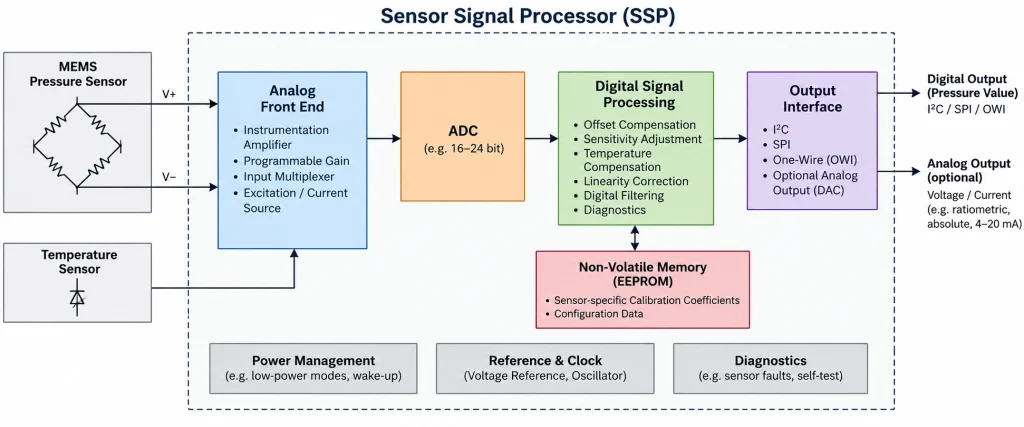
A Sensor Signal Processor typically combines several functional stages within a single integrated circuit.
The signal-processing chain generally consists of five steps:
- Signal amplification: A Programmable Gain Amplifier (PGA) amplifies the low-level sensor output to utilise the available input range of the converter.
- Analogue-to-digital conversion: An Analogue-to-Digital Converter (ADC) transforms the amplified analogue signal into digital measurement values.
- Digital compensation: Stored calibration coefficients correct offset, sensitivity, non-linearity and temperature-dependent deviations.
- Digital filtering: Signal-processing algorithms reduce measurement noise while maintaining the required response time.
- Output processing: The compensated measurement values are provided through an analogue or digital output interface, depending on the SSP architecture.
The Sensor Signal Processor therefore combines several essential signal-processing functions in a compact electronic solution.
The main advantage of a Sensor Signal Processor is its ability to compensate for variations in sensor characteristics.
Without compensation, changes in temperature, manufacturing tolerances and non-linear sensor behaviour can significantly affect measurement accuracy.
In particular, temperature compensation is essential for achieving stable performance across the specified operating temperature range.
Compared with conventional compensation using laser-trimmed resistor networks, digital signal conditioning offers greater flexibility during sensor calibration.
It can also simplify manufacturing by reducing the need for complex trimming equipment and additional production steps.
For MEMS pressure sensors, this approach enables consistent performance and flexible adaptation to different measurement requirements.
However, the benefits must be balanced against potential disadvantages, including additional power consumption and processing latency.
What are the most important parameters of a Sensor Signal Processor?
Selecting the appropriate Sensor Signal Processor requires careful consideration of several technical parameters.
These determine the achievable measurement accuracy, signal stability, response time and overall system performance.

| Parameter | Importance for sensor performance |
|---|---|
| ADC resolution | Determines the nominal digital resolution available for converting the analogue sensor signal. |
| Effective number of bits (ENOB) | Describes the usable resolution after considering noise and other non-ideal effects. |
| PGA gain | Determines how effectively the sensor output utilises the available ADC input range. |
| Supply voltage | Influence power consumption, bridge excitation and measurement stability. |
| Sampling rate | Determines how frequently the sensor signal is measured. |
| Digital filter bandwidth | Influences the balance between measurement noise and response time. |
| Signal latency | Describes the delay introduced by signal conversion and processing. |
| Calibration capabilities | Determine how accurately offset, sensitivity, non-linearity and temperature effects can be corrected. |
| Diagnostic functions | Enable monitoring of selected electrical faults and abnormal operating conditions. |
A Sensor Signal Processor should be selected based on the requirements of the complete sensor system rather than individual specifications alone.
For example, a higher nominal ADC resolution does not automatically result in better pressure measurement accuracy.
The effective resolution also depends on the sensing element, analogue front-end noise, sampling rate and digital filtering.
Similarly, reducing the digital filter bandwidth can improve signal stability but generally increases response time.
What role do voltage sources and signal noise play?
Stable voltage sources are particularly important in piezoresistive pressure sensors because fluctuations in the bridge excitation voltage can influence the measurement signal.
The Sensor Signal Processor must therefore provide or accommodate suitable excitation and reference conditions.
The overall noise level is determined by several components, including the MEMS sensing element, PGA, ADC and voltage reference.
In many applications, the piezoresistive sensing element itself represents a major source of measurement noise.
Consequently, the complete signal chain must be considered when evaluating sensor performance.
How do SSPs improve sensor calibration and temperature compensation?
Examples and applications of Sensor Signal Processors
Sensor calibration is essential for achieving accurate pressure measurements.
During calibration, the sensor is exposed to defined pressure and temperature conditions. The resulting measurement values are used to calculate correction coefficients.
A Sensor Signal Processor applies these coefficients to compensate for individual sensor characteristics.
For example, a typical multi-point calibration procedure may use seven measurement points across three reference temperatures and different reference pressures.
This allows offset, sensitivity and temperature-dependent deviations to be corrected.
For optimal temperature compensation, the temperature should ideally be measured directly at the MEMS sensing element.
This is particularly important when thermal gradients exist between the sensing element and the signal-processing electronics.
With suitable calibration, piezoresistive pressure sensors can achieve high accuracy across their specified operating conditions.
A Sensor Signal Processor can be integrated into various sensor architectures depending on the application requirements.
Typical examples include:
- Digital MEMS pressure sensors: SSPs provide amplification, calibration and digital output processing.
- Industrial pressure transmitters: Signal processing enables accurate pressure measurement and compensation under changing operating conditions.
- Medical pressure sensors: Digital compensation supports reliable measurements in demanding medical applications.
- Low-pressure sensors: Precise signal amplification and calibration help process the particularly small electrical signals generated by sensitive sensing elements.
Depending on the selected architecture, a Sensor Signal Processor may also include diagnostic functions such as signal-loss detection, supply-voltage monitoring and communication checks.
These features can support reliable operation and simplify integration into electronic systems.
Sensor Signal Processors and pressure measurement at All Sensors
Sensor Signal Processors are important components of modern pressure measurement technology. They enable precise signal conditioning, flexible calibration and reliable compensation of temperature-related measurement deviations.
At All Sensors, we specialise in high-performance MEMS pressure sensors for industrial, medical and other demanding applications.
Our product portfolio includes pressure sensors designed for applications requiring high accuracy, stability and reliable performance.
Whether you are developing a new measurement system or looking for a suitable pressure sensor for an existing application, our experts will help you identify the right solution.
Discover our pressure sensor portfolio or contact All Sensors for personalised technical advice.
Learn more about sensor signal processors
We interviewed Sandi Kocjan – Director of R&D for Sensors at HYB if you are interested in the interview, please visit our blog section or contact us for tailored support.